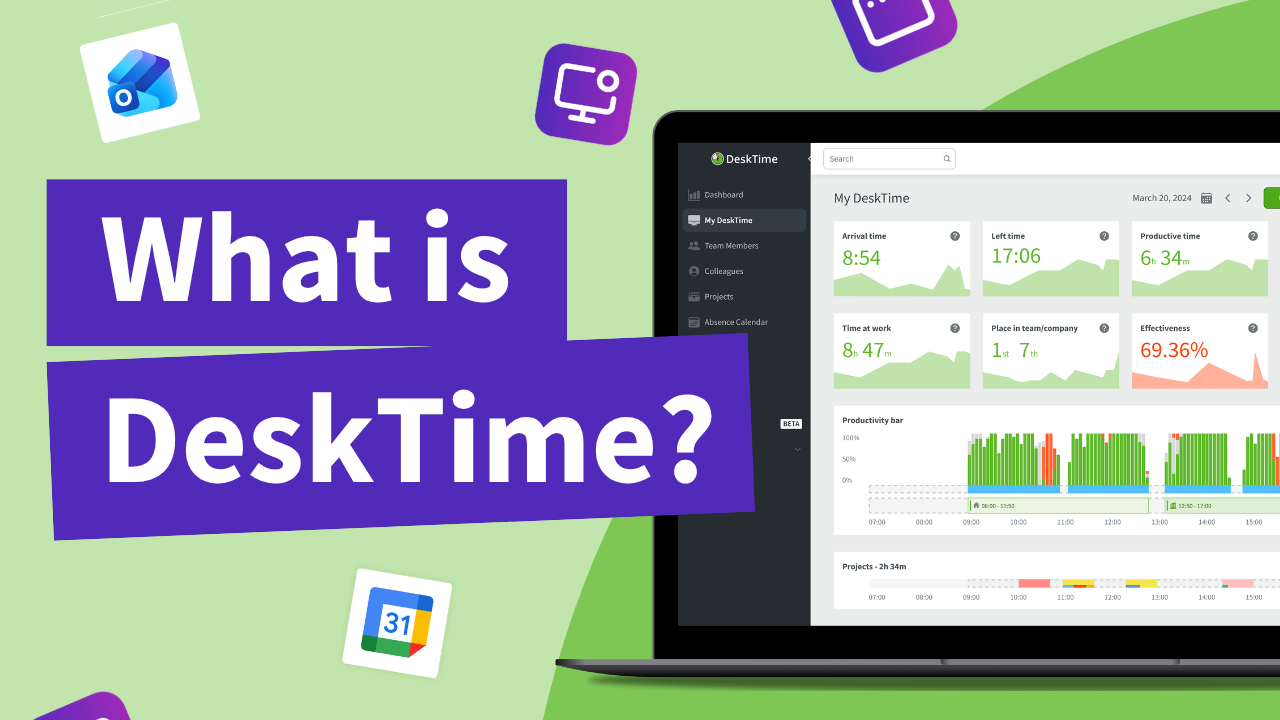
Join our free webinar on November 17 to discover what real data reveals about remote and hybrid work.

12 years of workplace research into modern productivity

Since 2014, DeskTime data has shaped workplace research on breaks, focus, and remote work, with findings cited by The Washington Post, TIME, and peer-reviewed journals.

12 years

of published research, 2014–2026

14+

citations in press & peer-reviewed research

26

original studies

Featured on:
The Washington Post logo
Forbes logo
Business Insider logo
TechRadar logo
The Washington Post logo
Forbes logo
Business Insider logo
TechRadar logo

How our productivity studies have shaped the conversation

The 52/17 rule is published

DeskTime usage data reveals an ideal work-break ratio. The Muse, The Washington Post, TIME, Fast Company, and Inc. all picked up the story the same year.

2014

Cited in Daniel Pink's "When"

The bestselling book on timing names DeskTime directly, introducing our research to a new audience.

2018

Compared to the Pomodoro Technique

Inc. revisits the 52/17 rule alongside the Pomodoro method, cementing it as a productivity benchmark.

2019

Independent product review

TechRadar publishes an in-depth, independent review of DeskTime, updated again in 2021.

2020

112/26: the post-pandemic ratio

DeskTime data shows a new work-break pattern as remote work becomes widespread. Fast Company covers the update.

2021

First peer-reviewed citations

The 52/17 study is cited in a Wiley journal and in the Journal of Singing.

2024

AI adoption research begins

New DeskTime studies track how quickly AI tools are becoming part of the workday.

2025

Global and seasonal studies published

New research covers the US–Europe productivity gap, seasonal trends, and the 6-hour workday debate.

2025

The Research Hub launches

Studies, press citations, and customer results move to a single, structured home, built to make DeskTime's findings easier to discover and use.

2026

Browse all studies

3 studies

Breaks & Focus | 2014–2025

Does the 52/17 rule really hold up?

DeskTime’s original 2014 study found that the most productive 10% of employees worked for an average of 52 minutes before taking a 17-minute break. The finding has since been revisited using newer workplace data.

Breaks & Focus | 2021

How did the work-break ratio change after 2020?

112 / 26 minutes of work/break, top performers

When DeskTime revisited the 52/17 study in 2021, the data showed a different pattern: top performers worked for an average of 112 minutes before taking a 26-minute break.

AI at Work | 2025

AI usage is tripling year-on-year among office employees

3Ă— year-on-year growth in AI tool usage

DeskTime analyzed app and website activity across thousands of accounts and found that the use of AI tools among office employees had roughly tripled year over year.

What our customers achieved

Explore customer stories from companies across industries and see the real results they’ve achieved with DeskTime.

730K+

users worldwide

174

countries

41M+

workdays tracked since 2011

Mapon logo
IT

How Mapon keeps flexible work balanced while serving 35K+ clients

See how Mapon uses DeskTime to support flexible work, balance workloads, and help employees stay accountable for their time.

NtoN logo
BPO

How NtoN replaced Clockify with automatic time tracking

See how NtoN, a 150-person outsourcing company, uses DeskTime data to improve processes and support employees.

Roadgames logo
IT

Trust and flexibility powered by automatic time tracking

Using DeskTime, Roadgames implemented flexible hours, workations, and productive time tracking for all employees.

DeskTime workplace research in the spotlight

See where DeskTime productivity studies have been featured in the press and cited by researchers.

The Washington Post

2014

"What the most productive workers have in common"

TIME

2014

"The Exact Perfect Amount of Time to Take a Break"

Fast Company

2014

"The Exact Amount of Time You Should Work Every Day"

Fast Company

2021

"Follow-up on the 112/26 update"

Inc.

2014

"The Magic Numbers for Maximum Productivity: 52 and 17"

Inc.

2019

"The Rule of 52 and 17 vs. the Pomodoro Technique"

The Muse

2014

"The Rule of 52 and 17"

TechRadar

2021

"Independent DeskTime review"

Hult Int'l Business School

2018

"Why 52 is the magic number"

In academic research

Laksanadjaja & Oviedo-Trespalacios

Human Behavior and Emerging Technologies (Wiley), 2024 — peer-reviewed citation. (2024)

Fennessy et al.

Journal of the American College of Radiology, vol. 18 — cites 52/17 as guidance for radiologists. (2021)

Manternach

Journal of Singing, vol. 81, no. 1 — cites the 52/17 ratio. (2024)

Till — "Exercise as Labour"

Societies, vol. 4, no. 3 — early academic citation. (2014)

Work with us

Whether you need data for a story, want to collaborate on research about productivity, or have an idea worth exploring, we’d love to hear from you.

Partner on a study

Work with our team to design and publish a study using DeskTime data.

Request anonymized data

Access aggregated, anonymized workplace data for academic or independent studies.

Media & press inquiries

Get data, expert commentary, or additional context on our findings for your story.

Suggest a research topic

Have a question about work, productivity, or how the modern workday is changing? It might be our next study.

Thumbnail for a video where Dr. Olivia Remes explains the importance of employee wellbeing to increase productivity

Pioneering smarter work since 2011

DeskTime helps organizations understand how work really happens. Our workforce data reveals patterns behind more productive workdays, including the widely cited 52/17 method explored by Cambridge researcher Dr. Olivia Remes. Here’s how we make it actionable.

Effortless time tracking

DeskTime runs quietly in the background, capturing real work patterns automatically—the same data that first uncovered the 52/17 work and break cycle.

Insights that respect people

Track apps, websites, and documents to understand workflow patterns and wellbeing trends, without invading privacy.

Fast and simple setup

Install, invite your team, and start gaining actionable productivity and wellbeing insights immediately.

For journalists & researchers

Reach our team directly for data requests, interviews, or a copy of our press kit.

Frequently asked questions

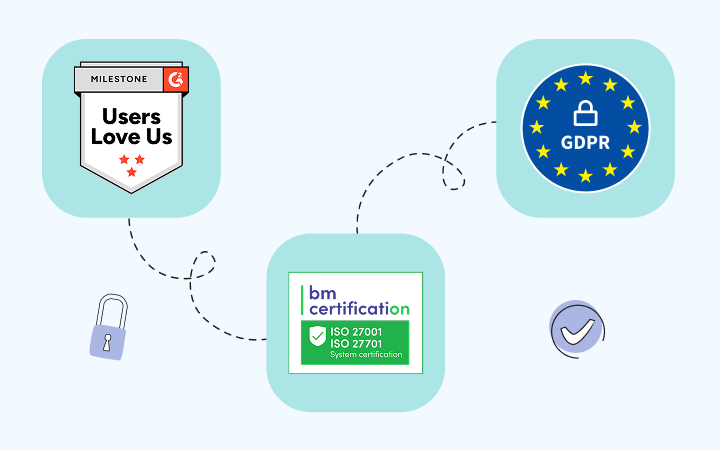
DeskTime is automatic time tracking software for productivity insights, built for small-to-medium-sized companies. It tracks time in the background, attributes hours to clients and projects, and shows leaders what work costs and how capacity is distributed across teams. Private Time and blurred screenshots keep employees comfortable. ISO 27001 and ISO 27701 certified.
Yes. The 52/17 finding has been cited in peer-reviewed publications, including a Wiley journal and the Journal of Singing, as well as in press outlets and Daniel Pink's book "When."
It's DeskTime's original finding that the most productive employees tend to work in roughly 52-minute stretches followed by 17-minute breaks. We've revisited it several times since 2014, most recently finding a 112/26 pattern after the shift to remote work, so the exact numbers shift, but the underlying idea has held up.
Every study is based on real, anonymized usage data from DeskTime's own user base, including app, website, and productive-time data aggregated across accounts, never individual identities.
Outlets including The Washington Post, TIME, Fast Company, Inc., and TechRadar have covered our studies, and the 52/17 finding has been referenced in peer-reviewed journals and in Daniel Pink's book "When."
Use the topic filters above the study grid, Breaks & Focus, Remote & Hybrid Work, AI at Work, and Global & Seasonal Trends, or scroll the timeline to find a study by year.
Some datasets are available on request for academic or independent research. Use the "Request anonymized data" option above to tell us what you're working on.
Use the "Partner on a study" option above to reach our research team directly. We regularly work with journalists, academics, and independent researchers.